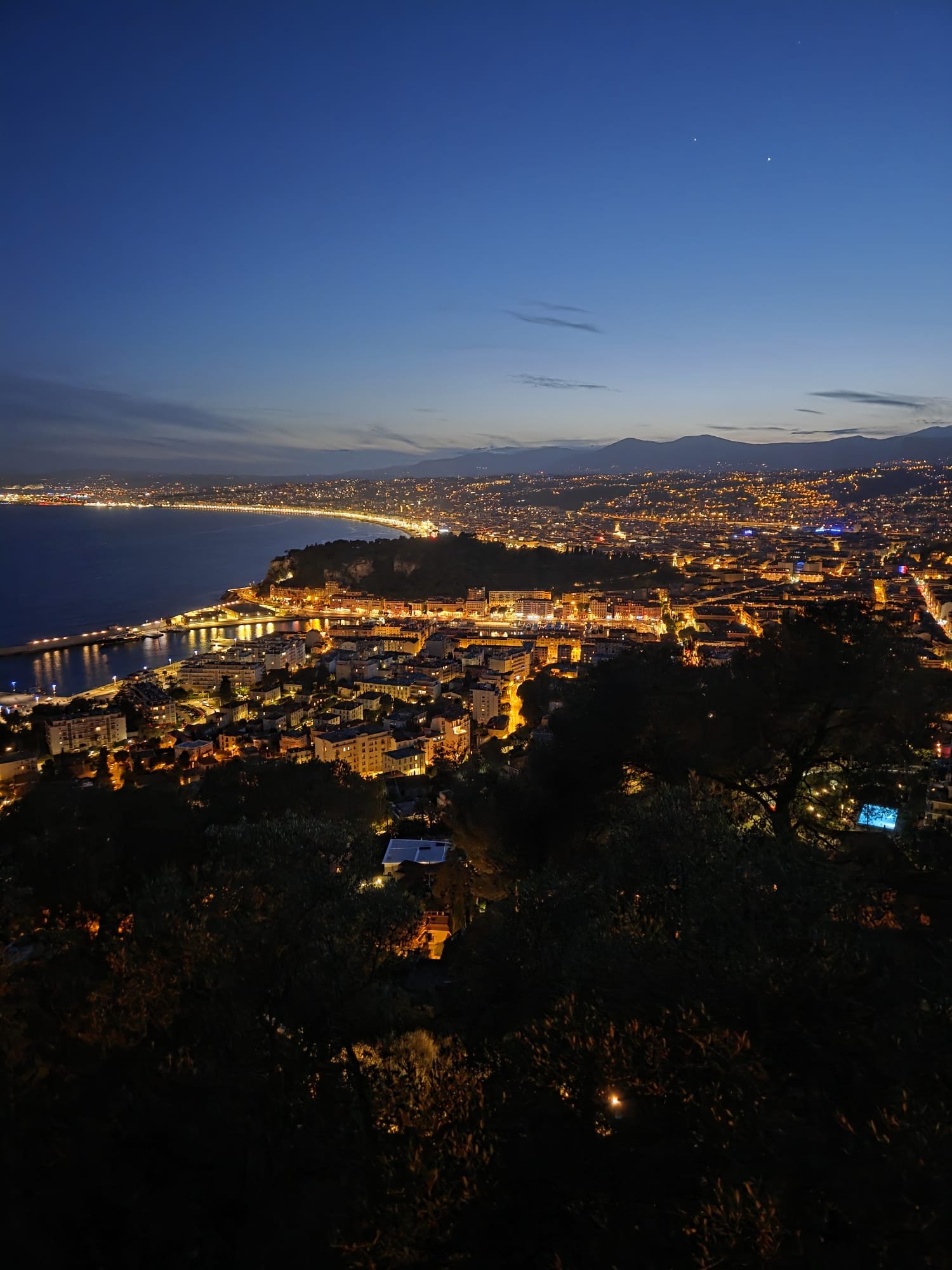
Nice welcomes around 3 million tourists a year — and after 20 years of driving them around this coast, I can tell you most make the same eight mistakes. Here they are, in the order they usually happen.
They rent a car
I understand the logic. Freedom. Flexibility. No depending on anyone.
Here's what actually happens. You spend forty-five minutes finding parking in Èze — a medieval village built on a cliff, with two streets and a car park designed in 1987 that hasn't been expanded since. You pay €22 to park in Cannes, walk fifteen minutes to the waterfront, and walk fifteen minutes back. You sit in traffic on the A8 between Nice and Antibes on a Tuesday in August and watch the clock move faster than the car.
If you decide a driver makes more sense, I’ve written a separate, honest guide on how to choose a private driver in Nice — including how to verify a licence in thirty seconds.
The Côte d'Azur was not designed for tourists with rental cars. It was designed for people who live here and know which road to take. The Corniche routes — Inférieure, Moyenne, Grande — are three completely different drives with three completely different characters. None of them are obvious on a GPS.
Rent a car if you're going inland, into Provence, somewhere without a coast road. On the Riviera itself, there are better options.
They spend three days in Nice and don't go past Villefranche
Nice is a good city. Good market, good light, good food if you avoid the Promenade des Anglais. But Nice is the entry point, not the destination.
Villefranche-sur-Mer is twelve minutes east by car. It looks like Nice did before it became a city. A bay so blue that Renoir painted it forty times. Almost no one goes. The cruise ships anchor there and send passengers into Nice instead.
Cap-Ferrat is another eight minutes. One of the most quietly wealthy pieces of land in Europe, mostly inaccessible from the road, almost entirely unknown to tourists who aren't specifically looking for it.
The Riviera starts getting interesting at Villefranche. Most visitors never leave Nice.
They go to Monaco for the Casino
Monaco is twenty-two kilometres from Nice. Most people go, see the Casino, see the port from a distance, take the same photograph from the same angle, and leave within three hours.
The Casino is a building from 1863 that you can see the outside of for free and the inside of for €17 and a jacket. It's beautiful. It's also not Monaco.
Monaco is the Rocher — the old rock — with a palace, a cathedral, and a neighbourhood that actually functions as a place people live. It's the Oceanographic Museum, one of the serious ones. It's the market in the Condamine at eight in the morning when the city belongs to the people who live in it.
Go to Monaco. But go early, go to the parts that aren't on the postcard, and give it more than a morning.
They go to Èze at the wrong time
Èze village is perched at 427 metres above the sea. The view is genuinely extraordinary. The village is genuinely beautiful.
It is also, between 10am and 4pm in summer, a stream of tour buses emptying three hundred people per hour onto two streets that weren't built for foot traffic.
Go at eight in the morning. Go in late afternoon when the buses have left. The village is the same village. The experience is not.
Go in May or September when there's a version of silence. Timing on the Riviera is everything, and nobody puts it in the guidebook because the guidebook can't account for when you actually wake up.
They confuse Cannes with the Croisette
The Croisette is a boulevard. It's pleasant. It's also where everyone who hasn't been to Cannes before goes, because it's in every photograph of Cannes.
Antibes is eight kilometres west. The old town — ramparts, a covered market, the Picasso Museum in a castle above the sea — is one of the most underrated afternoons on this coast. It's quieter than Nice, less performed than Cannes, and almost entirely free of the infrastructure of mass tourism.
If you're in Cannes, go to Antibes. If you're in Nice and you have one afternoon free, go to Antibes instead.
They try to do everything in one day
Monaco, Èze, Cap-Ferrat, Cannes, and Saint-Paul-de-Vence in a single day. I've seen this itinerary. I've driven it. It's a day of sitting in a car, arriving somewhere, looking at it for forty minutes, and leaving before you've had time to understand why you came.
Saint-Paul-de-Vence is a village with galleries, a Miró, a Giacometti, a cemetery where Marc Chagall is buried, and a café terrace where you should sit and not rush. It rewards stopping. Almost no tourist itinerary gives you time to stop.
Pick two places. Go slowly. Eat somewhere that doesn't have a menu translated into four languages outside the door.
The Côte d'Azur is not a checklist. The people who come back are the ones who figured that out on the first trip.
They take the train to Cap-Ferrat
There is no train station at Cap-Ferrat.
The peninsula has one road in and one road out. The train stops at Beaulieu-sur-Mer, one kilometre from the entrance. From the station you either take a taxi — there are approximately two available at any given time — or you walk along a road without a pavement in the July heat.
Practical note
Getting to Cap Ferrat without a car
The Villa Ephrussi de Rothschild alone is worth the trip. Nine themed gardens, a pink villa on the crest of the peninsula, sea on both sides. But plan the last kilometre in advance. Uber coverage on the Cap is unreliable — several clients have tried and waited. A private driver who drops at the villa entrance and picks up at Plage Passable at an agreed time is the practical solution. See the full Cap Ferrat guide.
They eat on the Promenade des Anglais
The Promenade is for walking. The restaurants on the Promenade are for people who haven't eaten in Nice before and won't eat there again.
Go to the old town. Go to the Cours Saleya market in the morning and understand what people actually eat here. Go to a restaurant on a street you had to look for.
The best meals on the Côte d'Azur happen in places without a view of the sea. The sea is free. The food on the seafront is expensive for what it is.
The Riviera is a genuinely extraordinary place to spend time, done at the right pace, with some sense of where to be and when.
Everything above I've learned from the driver's seat — from watching where people go, from hearing what they wish they'd known, and occasionally from being the person who could tell them, one trip too late.
Questions worth answering
Should I rent a car on the French Riviera?
For travel along the coast — Nice, Monaco, Cannes, Antibes — a rental car creates more problems than it solves. Parking in summer is expensive, limited, and time-consuming. The Corniche routes require local knowledge. A private driver or a combination of train and taxi works better and costs less stress. A rental makes sense if you're heading inland into Provence or the Alpes-Maritimes.
What time should you visit Èze village?
Before 10am or after 4pm in summer. Between those hours, tour buses empty hundreds of visitors per hour onto two streets. The village is perched at 427 metres — the views are the same at 8am as at noon, with a fraction of the people.
Is there a train to Cap Ferrat?
No. The nearest station is Beaulieu-sur-Mer, one kilometre from the peninsula entrance. A bus serves the Cap on a limited schedule. A private driver or taxi is the practical solution, especially if you want to visit both villas and the coastal path in the same day.
Where should you eat in Nice?
Not on the Promenade des Anglais. The old town (Vieux-Nice) and Cours Saleya area are where people who live here eat. The best meals happen on streets you had to look for — and they're cheaper than the seafront.
Is Antibes worth visiting instead of Cannes?
Yes. The old town — ramparts, covered market, the Picasso Museum in a castle above the sea — is one of the most underrated afternoons on the Riviera. Quieter than Cannes, less tourist infrastructure, eight kilometres west. Most visitors who spend a morning there wish someone had told them about it sooner.
If you want the version of this coast that most visitors don't get — the right timing, the right roads, the right order — that's what a private day is for. Tell me what interests you and I'll build the day around it.